The Real Challenges of Image Quality Tuning in Camera Products – And How Renesas RZ MPUs + Emmetra Solve Them

Updated: Jan 14

This article is co-written by Johannes Brücker & Ajay Basarur (Emmetra)

Johannes Bruecker
Principal Business Development Engineer at Renesas

Renesas MPUs from the RZ family are high-performance solutions tailored for a wide range of applications, from 2D/3D graphics and real-time control to industrial automation and Vision AI. The RZ/V series, featuring embedded AI acceleration, is purpose-built for Vision AI and supports diverse use cases such as smart cameras, drones, and security systems.
Reconizing the challenges developers face when building AI applications from scratch, Renesas not only provides comprehensive development tools, sample code, and ready-to-use AI use cases, but also collaborates with trusted partners Emmetra. Selecting the right sensor or lens and tuning the ISP can be complex and costly. Emmetra’s solution addresses these pain points by reducing BOM costs and accelerating time-to-market, while seamlessly integrating with Renesas RZ/V and RZ/G3E devices to streamline AI development.

Ajay Basarur
CEO & Co-Founder at Emmetra
Building a hardware product is hard! Building an embedded hardware product is harder!! Building an embedded camera product? That’s where things get truly interesting.

If you’ve ever architected or managed an embedded camera program, you already know what I mean. Over the past 15 years working across consumer, industrial, and automotive applications—from action cameras and medical imaging devices to retail, lawn mowing systems—I’ve seen just how intricate camera product design can become.
In surveillance systems, the camera is the product. In other devices, cameras are mere enablers—but they often introduce the most complex engineering trade-offs. Every product category has its own specialization, yet nothing compares to the multidimensional puzzle a camera introduces.
Where Every OEM’s Dilemma Begins
Whether you’re building your first vision-enabled device or preparing a next-generation revision, the foundational questions remain the same:
Which SoC or processor best fits the application?
Which image sensor and lens pairing delivers the right performance-cost balance?
What skill mix does the engineering team need to design efficiently?

Meanwhile, procurement teams face their own set of pressures:
How do we optimize component costs without compromising image quality?
Can we simplify the Bill of Materials to reduce complexity and maintenance?
How can we manage supply continuity and avoid EoL risks over a five- to seven-year product lifecycle?
Once engineering and procurement align, the real search begins—identifying the right SoC, sensor, and supporting components. But how do you know you’ve arrived at the most optimal design? What distinguishes companies that consistently build great camera products?
What the Best Camera Product Makers Do Differently
The best camera teams recognize that performance doesn’t come from parts alone. It comes from control and insight. They:
Choose SoCs that allow deep access to imaging subsystems—ISPs, NPUs, DSPs.
Know that a sensor and lens are just the beginning; tuning defines quality.
Adapt the ISP pipeline for both machine vision and human vision outcomes.
Integrate ISPs intelligently with encoders to trim bandwidth and storage needs.
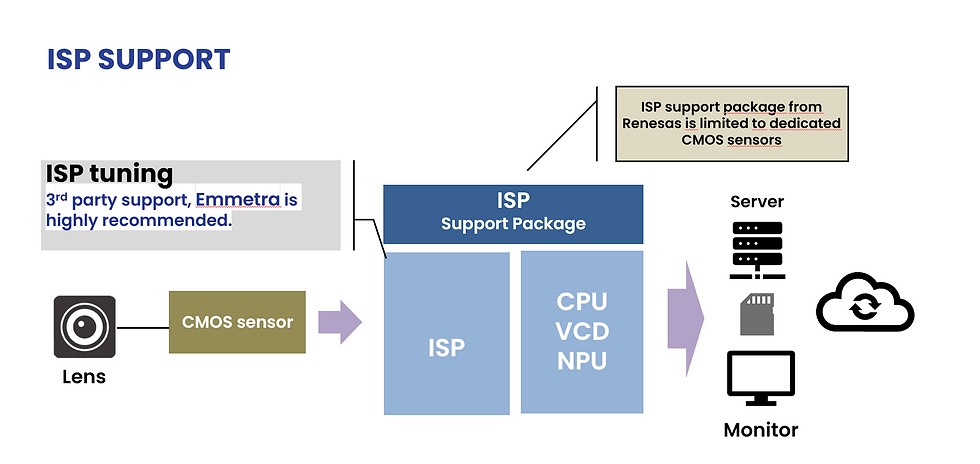
However, access is often tied to scale. Unless your production runs into millions of units, semiconductor vendors typically limit ISP access. Then there is an imaging lab cost. That leaves smaller OEMs facing hard trade-offs:
No direct ISP access or tuning capability.
Reliance on off-the-shelf camera modules.
Inability to fine-tune performance for diverse applications.
So, how can smaller-volume manufacturers still compete at the level of major OEMs?
AUTOIQ.ai — Rethinking How Cameras Get Built
At Emmetra, our team has lived this problem for years. Our background spans imaging system design, SoC integration, and real-world camera deployment. After seeing so many OEMs struggle with inaccessible ISPs and long learning curves, we built AUTOIQ.ai to simplify the process.
AUTOIQ.ai allows camera builders to:
Work without needing direct ISP access from SoC vendors.
Empower existing engineers to achieve advanced imaging results.
Tune image quality contextually for each machine vision use case.
Optimize video pipelines in-loop with the ISP to cut storage and bandwidth use.
In short, it helps you move from dependency to autonomy.
Renesas and Emmetra — Enabling Smarter Vision Design
Our partnership with Renesas is central to this mission. Renesas’ RZ family—especially the RZ/V series—delivers embedded AI acceleration purpose-built for Vision AI applications like smart cameras, drones, and industrial systems. Their ecosystem includes ready-to-use AI models, sample code, and development tools.
Emmetra complements this by adding what most hardware teams need next: image system intelligence.
With AUTOIQ.ai integrated into the Renesas RZ/V and RZ/G3E platforms, OEMs can:
Test and select the right sensor and lens in weeks, not months.
Access ISP tuning capabilities without deep SoC programming.
Reduce BOM costs and accelerate production ramps.
Cut encoding bitrates by up to 40%—saving memory and allowing use of lower-cost Wi-Fi 4 chipsets instead of Wi-Fi 6 or 7.
Building Camera Products Like LEGO Blocks
The vision we share with Renesas is simple: make camera product design accessible to every OEM—large or small. With the right architecture and intelligent automation, building camera-enabled products should feel modular, iterative, and fast.
That's what Emmetra's AUTOIQ.ai with Renesas brings into the table. Checkout our latest webinar recording on eBoM Cost Optimization for Vision Application using Emmetra AUTOIQ.ai on Renesas MPUs.
Article co-written by:
Ajay Basarur
CEO & Co-Founder at Emmetra
Johannes Bruecker
Principal Business Development Engineer at Renesas
Comments